
I once watched a batch of 40 EPA 8270 soil extracts fail calibration because the autosampler had been fitted with the wrong septa. The lab had switched suppliers to save four cents per vial, and the new caps used a 1.5 mm silicone disc instead of the 3.0 mm PTFE-lined silicone the method validation was built around. Silicone bleeds siloxanes, the GC-MS saw them at m/z 73, 207, and 281, and the internal standard recovery drifted to 62 percent by the end of the run. Nobody had touched the instrument. That is the kind of failure mode that regulated methods are designed to catch, and it is also the kind that aijiren consumables either prevent or cause depending on whether you read the spec sheet before you sign the PO.
This article covers what actually matters when you put aijiren vials, caps, septa, and syringe filters into a method that has to survive an EPA audit, an ISO 17025 assessment, or an AOAC collaborative study. I will give you the numbers I use when I qualify a lot, the failure modes I have personally debugged, and a decision checklist you can hand to a procurement manager who thinks a vial is a vial.
Under U.S. EPA SW-846, a method is not just the instrument parameters. Method 8000D defines the quality control that has to hold, and Method 8270E, 8260D, and 8082A each specify injection volume, internal standard concentration, and calibration acceptance criteria. What they do not do is name a vial. That gap is where labs get into trouble, because the auditor will ask you to demonstrate that your sample container did not contribute to the analytical result.
ISO/IEC 17025:2017 clause 6.4 covers equipment, and clause 7.1.4 covers method validation. Consumables that contact the sample fall under both. If you cannot show a certificate of analysis, a lot traceability record, and a blank run proving the consumable is clean, you have a finding waiting to happen. AOAC Official Methods have the same expectation: the collaborative study that validated the method used specific materials, and any substitution requires you to re-demonstrate equivalency.
My working rule is simple. Any consumable that touches the sample before the detector is part of the method. Treat it with the same documentation discipline as a calibration standard.
What aijiren actually makes, and where it fits
Aijiren is a Chinese manufacturer of chromatography consumables with a broad catalog: 2 mL autosampler vials, 9 mm and 11 mm crimp and screw caps, septa in silicone, PTFE, and PTFE-lined silicone, syringe filters in PES, PTFE, nylon, and PVDF, and a range of HPLC and GC accessories. The catalog is deep enough that you can standardize an entire lab on one supplier, which is the appeal for procurement. The risk is that the catalog is also deep enough that a buyer can accidentally order the wrong septum for a method that has been validated for three years.
You can see the full line at Aijiren at aijirentechinc.com, and the vial-specific catalog at Chromatography Vial at chromvials.com. For method work, the documents you need from the supplier are the CoA, the dimensional drawing, and the extractable/leachable data. If a supplier cannot produce all three on request, that supplier is not ready for regulated work regardless of price.
Vial and cap selection against method requirements
Dimensions and the 2 mL standard
The 2 mL autosampler vial is defined by 12 x 32 mm body dimensions, a 6 mm opening, and a 9 mm crimp or screw thread. These are not arbitrary. The autosampler tray geometry, the needle depth, and the vial height sensor on an Agilent 7693A or a Thermo TriPlus RSH are all built around them. A vial that is 0.3 mm out of tolerance on the neck can cause needle bending or septum coring.
For methods with limited sample volume, the 300 µL and 150 µL inserts are common, and the insert has to sit flush in the vial bottom. A loose insert means the needle hits the insert wall and bends. I have seen labs lose a full day to that.
Septa: the single biggest source of contamination
Septa are where regulated methods live or die. The three types I specify:
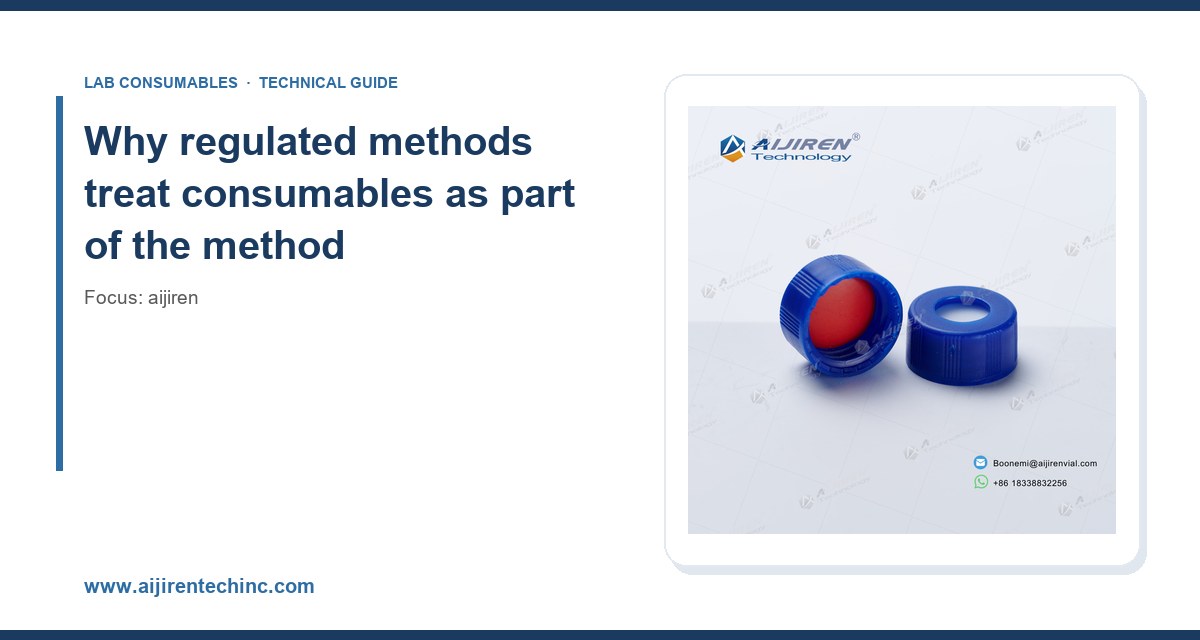
- PTFE-lined silicone, 3.0 mm thick, 9 mm diameter: the default for GC and GC-MS. The PTFE face is inert and prevents silicone bleed. Puncture count before coring: 3 to 5 injections per position, not 20. The 3.0 mm thickness matters because thinner septa (1.5 mm) core faster and leak.
- Pure PTFE, 0.25 mm: for HPLC with aggressive solvents (DMSO, THF, dichloromethane). No silicone, no bleed, but it does not reseal well. Use it for single-injection positions or where the autosampler needle is a side-port design.
- Silicone with a PTFE/silicone laminate: for headspace. The laminate holds pressure better at the 80 to 120 °C headspace oven temperatures used in EPA 8260D.
The failure mode I see most: a lab uses a 1.5 mm silicone septum for a 100-injection sequence, the septum cores at injection 40, the needle punches a plug into the vial, and the run is lost. The fix is a 3.0 mm PTFE-lined septum and a maximum 5 punctures per position rule written into the SOP.
Caps and torque
Crimp caps are 9 mm aluminum with a 11 mm outer diameter. The crimping force matters. Too little and the seal leaks under the 10 to 15 psi headspace pressurization; too much and you crack the neck. A hand crimper should be set so the cap skirt deforms evenly and the vial can be inverted without leaking. For screw caps, I specify 0.5 to 0.8 N·m torque, which is roughly hand-tight plus a quarter turn. A torque screwdriver is worth the $80.
For more on the specific vial and cap geometries, the Hplc Vial at hplcvialfactory.com catalog has dimensional drawings that match the GPI 9 mm thread standard. Check that the thread finish is GPI-compliant before you commit a method to it.
Syringe filters and extract cleanup
EPA 8270E extracts from soil go through a filter before injection. The filter material matters more than most people think. Nylon adsorbs semivolatile compounds with acidic functional groups; I have seen 2,4-dinitrophenol recovery drop to 70 percent on a nylon filter when the same extract gave 98 percent on PTFE. For semivolatiles, use PTFE or PVDF, 0.45 µm, 13 mm or 25 mm. For aqueous samples with high particulate load, PES at 0.22 µm is fine.
The filter housing also matters. A polypropylene housing can leach oligomers that show up as late-eluting peaks in the 30 to 40 minute window of a 60 m DB-5MS run. Specify HPLC-grade polypropylene and ask for the extractable data. Aijiren’s filter line is cataloged at Chromatography Products at chromatographyforsale.com if you need to cross-reference part numbers.
Cross-referencing against major instrument platforms
Before you qualify a lot, cross-reference the consumable against the platform it will run on. Agilent chromatography consumables and columns publishes dimensional specs for their 5182-series and 5183-series vials and caps. If the aijiren part number is a direct cross, the dimensions should match to within ±0.1 mm. If they do not, do not use it in a validated method without re-validation.
The same applies to Thermo Fisher chromatography and sample handling hardware. The TriPlus autosampler has a specific needle guidance geometry that is less forgiving of out-of-tolerance vial necks than the Agilent 7693A. I have seen a batch of vials run fine on Agilent and jam on Thermo. That is a dimensional tolerance problem, not a supplier quality problem, but you only find it by testing on the actual platform.
For method development and troubleshooting reference data, Restek technical resources for chromatography has the most useful septa bleed and filter adsorption data I have found in one place. Their application notes on semivolatile recovery through different filter media are worth printing and keeping in the method binder.
Qualification protocol: what I actually run
When a new lot of aijiren vials and septa arrives, I do not just check the CoA. I run a three-part qualification before the lot goes into the regulated workflow.
Part 1: dimensional check
Sample 30 vials from the lot. Measure body diameter, height, neck diameter, and thread pitch with calipers. Acceptance: 12.00 ± 0.10 mm body, 32.00 ± 0.20 mm height, 6.00 ± 0.05 mm opening. Reject the lot if more than 2 of 30 are out of tolerance.
Part 2: blank injection
Fill 10 vials with HPLC-grade solvent (methanol for GC, water/acetonitrile for HPLC), cap with the lot septa, and inject on the method you will use. Acceptance: no peak greater than 3x the method detection limit in the retention window, and no siloxane peaks at m/z 73, 207, 281 above the baseline established with the previous lot.
Part 3: puncture and leak test
Puncture one septum 5 times with the autosampler needle, then pressurize the vial to 15 psi and check for leak-down over 60 seconds. Acceptance: no measurable pressure drop. If it leaks, the septum is too thin or the crimp is too loose.
This protocol takes about 4 hours and has saved me from at least three bad lots in five years. It is cheap insurance against a failed run that costs 10 times as much in instrument time and re-extraction.
Comparison checklist: consumable selection by method type
Here is the decision table I hand to lab managers when they are standardizing a method. The numbers are the ones I have validated against EPA 8270E, 8260D, and 8082A, and against AOAC 2007.01 for pesticide residues.
- GC-MS semivolatiles (EPA 8270E): 2 mL clear glass vial, 12 x 32 mm, 9 mm screw thread, PTFE-lined silicone septum 3.0 mm, maximum 5 punctures. Filter: PTFE 0.45 µm. Blank acceptance: no siloxane above 3x MDL.
- GC-MS volatiles (EPA 8260D): 40 mL amber VOA vial with PTFE-faced silicone septum, 0.125 inch thickness, headspace-rated to 120 °C. Crimp or screw cap with 0.5 to 0.8 N·m torque. No filter.
- GC-ECD organochlorines (EPA 8082A): 2 mL amber vial, PTFE-lined septum, maximum 3 punctures (ECD is sensitive to silicone bleed at low ppb). Filter: PTFE 0.45 µm, pre-rinsed with hexane.
- HPLC pesticide residues (AOAC 2007.01): 2 mL amber vial, PTFE/silicone septum, 0.2 µm PVDF filter for final cleanup. Blank acceptance: no phthalate peaks at 280 nm.
- HPLC with aggressive mobile phase (DMSO, THF): 2 mL vial, pure PTFE 0.25 mm septum, single-use positions. No silicone anywhere in the flow path.
If a method is not on this list, the default is PTFE-lined silicone 3.0 mm and PTFE 0.45 µm filter until you have data saying otherwise. That default has never failed me in a regulated audit.
Troubleshooting checklist
When a regulated method starts failing QC and the instrument looks clean, work through this list before you touch the column.
- Internal standard recovery drifting below 70 percent by end of run: check septum puncture count. More than 5 punctures per position is the usual cause. Replace septa and re-run.
- Siloxane peaks at m/z 73, 207, 281 in GC-MS blanks: septum bleed. Confirm the septum is PTFE-lined, not plain silicone. Check the lot CoA.
- Needle bending or autosampler errors: vial dimensional tolerance. Measure 30 vials. Check insert seating.
- Leak-down on headspace pressurization: crimp torque too low or septum too thin. Re-crimp at the correct setting and re-test.
- Low recovery of acidic semivolatiles: nylon filter adsorption. Switch to PTFE or PVDF.
- Late-eluting unidentified peaks in HPLC: polypropylene housing leachables. Switch to a higher-grade housing or pre-rinse the filter with 5 mL of mobile phase.
- Calibration curve failing at low end: vial or septum contamination at the MDL level. Run a solvent blank through the full consumable set.
This list covers about 80 percent of the consumable-related QC failures I have seen in 15 years. The other 20 percent are usually a supplier change that nobody documented.
Documentation and audit readiness
For ISO/IEC 17025 clause 7.1.4 and EPA method audits, you need three things on file for every consumable lot: the CoA, the lot number linked to the samples it was used for, and the qualification data from the three-part protocol above. If you cannot produce all three within 10 minutes of an auditor asking, you have a finding.
I keep a simple log: lot number, date received, qualification date, qualification result, and the sample batches the lot was used for. It is one spreadsheet. It has saved two labs from a major finding.
One more thing. Do not let procurement substitute a “compatible” part number without a method impact assessment. The four cents per vial you save is not worth the re-validation cost, which for a full EPA 8270E validation runs to about $8,000 to $12,000 in instrument time and analyst hours. I have seen that trade made three times in my career. It has never worked out.
Takeaway
Regulated methods do not care about the brand on the box. They care about dimensional tolerance, extractable profile, septum thickness, puncture count, and documentation. Aijiren can meet those requirements, but only if you qualify the lot, cross-reference the dimensions against the platform, and write the puncture limit and torque value into the SOP. The consumable is part of the method. Treat it that way and the audit is boring, which is exactly what you want.
References & further reading
Related resources from our lab consumables network:
- Aijiren at aijirentechinc.com
- Chromatography Vial at chromvials.com
- Hplc Vial at hplcvialfactory.com
- Chromatography Products at chromatographyforsale.com
External references and standards:

