
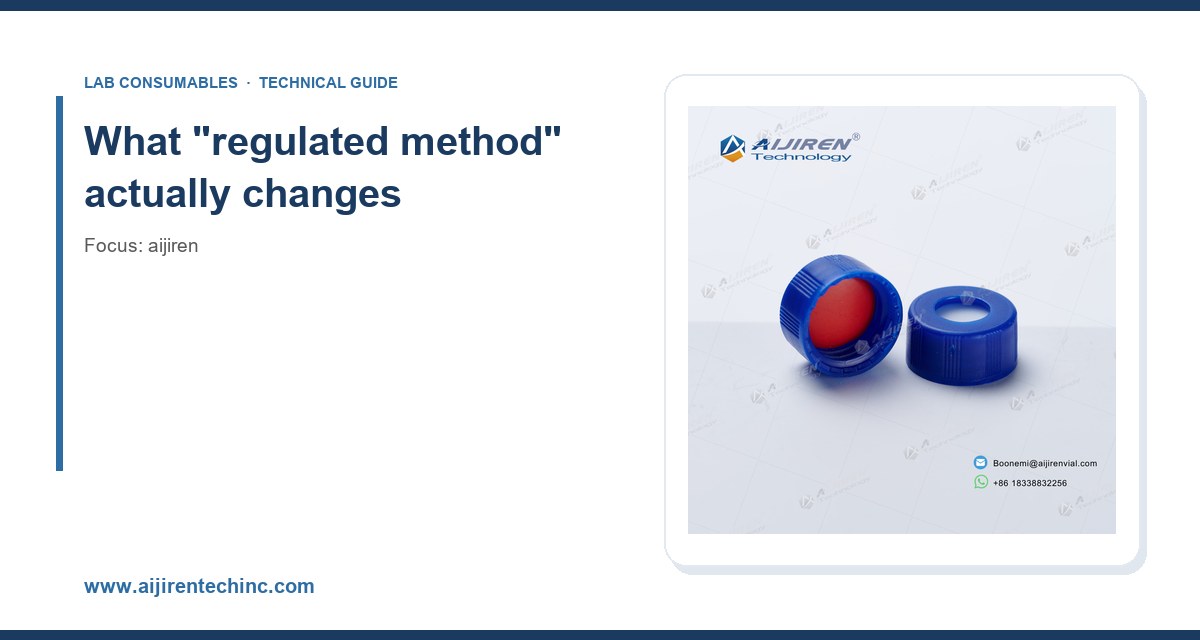
I once lost three weeks of method validation work because a 9 mm screw-thread vial from an unqualified supplier had a neck ID that ran 0.3 mm wide. The autosampler needle punched through the septum at a slight angle, the GC inlet leaked, and my internal standard response dropped 18% on the fourth injection of every sequence. The method was fine. The vial was not. That experience shaped how I think about regulated analytical methods: the chemistry in the SOP is only half the story. The other half is the consumables sitting between the sample and the detector, and whether they can survive the compliance audit that follows.
This article covers what procurement managers, lab managers, and analytical chemists need to know when the method is not just a method but a regulated method: an EPA SW-846 procedure, an ISO standard, or an AOAC official method. The rules change. Tolerances tighten. Documentation requirements multiply. And the consumables you buy have to hold up under all of it.
A regulated method is a procedure that a government agency, a standards body, or an industry consensus organization has published and that a laboratory is legally or contractually bound to follow. The three most common families in environmental, food, and industrial testing are EPA SW-846 (hazardous waste), ISO methods (water quality, air quality, food), and AOAC Official Methods of Analysis (food, feed, dietary supplements). Each one carries its own compliance burden, and each one treats consumables differently.
The EPA SW-846 framework
SW-846 is the EPA’s Test Methods for Evaluating Solid Waste, Physical/Chemical Methods. It is not a single document; it is a rolling compilation of methods (3010 through 9000 series) that laboratories use under RCRA and CERCLA programs. The key thing about SW-846 is that it is performance-based. Method 8000D, the determinative chromatography chapter, explicitly permits modification of columns, temperature programs, and carrier gas as long as the laboratory demonstrates equivalent performance through the initial demonstration of capability (IDOC) and ongoing quality control.
That flexibility is real, but it comes with a catch. When you swap a column or a vial, you have to prove the method still meets the performance criteria: calibration linearity of 0.995 or better, method detection limit (MDL) at 3x the standard deviation of seven replicates, surrogate recovery within the method window (often 70 to 130% for aqueous matrices), and matrix spike recovery within 75 to 125%. If your consumable introduces variability, you will see it in these numbers before you see it in the chromatogram.
There is a second layer to SW-846 that catches people: the method defines the QC acceptance criteria, but the laboratory defines the initial demonstration of capability (IDOC) data package that proves the method works in that specific lab. The IDOC runs four to seven replicates of a mid-level standard through the full method, including the sample preparation and the consumables. If you change vial suppliers between the IDOC and routine analysis, you have changed a variable in a validated system. Most labs do not re-run the IDOC after a consumable change. Most labs are also one audit away from a finding on that exact point.
The ISO approach
ISO methods (for example ISO 17025 for laboratory competence, ISO 5667 for water sampling, ISO 11885 for ICP-OES metals, ISO 6468 for organochlorine pesticides) tend to be more prescriptive than SW-846 on the analytical side but leave consumable selection to the laboratory. What ISO 17025 does mandate is traceability of measurement and documented control of external providers. In practice, that means your vial and septum supplier needs a certificate of analysis, a documented specification, and a change-notification process. If your supplier cannot tell you when they changed their septum formulation, you have a nonconformity waiting to happen.
ISO 17025 clause 6.6 (externally provided products and services) is the one that bites. It requires that you evaluate, select, and monitor suppliers, and that you have records of that evaluation. For a consumable like a septum, that means a documented specification, an incoming inspection record, and a periodic performance verification. I have seen labs pass an ISO 17025 assessment with a one-page supplier questionnaire and a retained sample of each lot. I have also seen labs fail because they could not produce a specification for the vial they had been buying for six years. The difference was documentation, not chemistry.
AOAC Official Methods
AOAC methods (for example 2007.01 for pesticide residues in foods by GC-MS, 2011.04 for melamine in milk, 2014.09 for vitamin D in infant formula) are collaborative-studied methods. They are validated across multiple laboratories, and the validation is tied to specific consumable configurations. If AOAC 2007.01 was validated with a particular column dimension and a specific sample preparation protocol, deviating from that configuration requires a single-laboratory validation (SLV) under the AOAC guidelines. That is not a five-minute exercise. It runs weeks and costs thousands of dollars.
The AOAC SLV protocol requires a minimum of three concentration levels, six replicates per level, and recovery and precision statistics that meet the method’s published criteria. For a method like 2007.01, that is 18 injections per matrix, run on at least two different days, with a full calibration curve each day. If you change a column dimension from 30 m x 0.25 mm x 0.25 µm to 30 m x 0.25 mm x 0.50 µm, you have changed the method. You need the SLV. Budget two to four weeks and a few thousand dollars in analyst time.
So the practical rule is: SW-846 gives you room to swap consumables if you prove performance; ISO gives you room if you document traceability; AOAC gives you almost no room at all without a formal revalidation. Know which regime you are in before you buy anything.
Why the consumable is part of the method
Every regulated method has a chain of custody from sample container to detector. The vial, cap, septum, syringe, column, and liner are all links in that chain. A weak link does not just cause a bad injection; it causes a QC failure, which triggers a corrective action, which triggers a re-run, which eats your turnaround time and your profit margin.
I have seen this play out in autosampler trays again and again. The common failure modes are boring and predictable:
- Septum coring. A low-quality silicone septum sheds particles into the vial after 20 to 30 punctures. Those particles land on the column inlet, cause peak tailing, and eventually plug the frit. On a 30 m x 0.25 mm x 0.25 µm GC column, a single cored particle can add 0.5 to 1.5 seconds to the retention time of late-eluting compounds.
- Neck dimension drift. A vial with a 9 mm neck that measures 9.3 mm instead of 9.0 mm will not seat squarely in the autosampler gripper. The needle enters at an angle, the septum tears, and you get a leak at the inlet. GPI 9 mm thread specifications (the Glass Packaging Institute standard that most autosamplers reference) call for a neck finish tolerance of ±0.15 mm. Cheap vials routinely miss it.
- Septum bleed. Silicone septa outgas at inlet temperatures above 250 °C. The bleed shows up as siloxane peaks at m/z 73, 147, 207, 281 in GC-MS. If your method uses selected ion monitoring at those masses, you have a problem.
- Vial adsorption. Untreated borosilicate glass adsorbs basic compounds (amines, quaternary ammonium salts) and some pesticides. For methods like EPA 8270 (semivolatile organics) or EPA 8330 (explosives), silanized or deactivated glass is not optional.
- Cap torque inconsistency. Hand-crimped or hand-screwed caps vary from 0.5 to 3.0 N·m across a batch. Autosampler needles need a consistent septa compression to puncture cleanly. The target for most 9 mm screw caps is 1.2 to 1.5 N·m; for 11 mm crimp caps, 1.0 to 1.2 N·m with a proper crimper.
None of these are exotic. All of them show up in audits. And all of them are avoidable with the right consumable specification and the right supplier.
Selecting vials and septa for regulated work
When I specify vials for a regulated method, I work from the method requirements backward. The method tells me the injection volume, the solvent, the inlet temperature, and the detector. Those four parameters narrow the choice fast.
Glass grade and surface treatment
Use Type I borosilicate glass (USP Type I, ASTM E438) for any method involving pH-sensitive analytes, basic compounds, or trace metals. Type I glass has a hydrolytic resistance that keeps sodium and other alkali leaching below 1 ppm under autoclave conditions. Type II (soda-lime treated) is acceptable for neutral organics in methanol or acetonitrile. Type III is for general use only and should not appear in a regulated method.
For methods with basic analytes (EPA 8270 amines, AOAC 2007.01 carbamates), specify deactivated glass. A good deactivation holds the silanol activity below the level where peak tailing exceeds a USP tailing factor of 1.5. If the supplier cannot give you a tailing factor specification, they have not deactivated the glass properly.
One more detail that gets overlooked: the glass color. Amber glass is the default for light-sensitive analytes (vitamins, some pesticides, nitroaromatics), but amber glass is made by adding iron oxide to the melt, which raises the extractable iron background. For trace metals methods at the low µg/L level, use clear Type I glass and shield the autosampler tray instead. I learned that one the hard way on an EPA 200.8 lead method.
Septum selection by inlet temperature and puncture count
This is where most labs cut corners and pay for it later. The septum is the single most failure-prone consumable in the autosampler path.
- Standard silicone (red rubber / silicone sandwich): rated to 200 to 220 °C. Good for 30 to 50 punctures. Use for HPLC and low-temperature GC. Not acceptable for split/splitless inlets above 250 °C.
- Silicone/PTFE sandwich: rated to 250 °C. Good for 50 to 100 punctures. The PTFE face is solvent-resistant; the silicone provides resealability. This is the workhorse for most EPA 8000-series methods.
- Molded silicone with PTFE facing (premium): rated to 300 °C. Good for 100 to 200 punctures. Use for EPA 8260 (volatile organics) and any method with a hot inlet and a long sequence.
- Bimetal (silicone + PTFE + silicone): rated to 350 °C. Good for 100 punctures. Use for high-temperature GC methods and for methods that run 24-hour sequences without operator intervention.
For HPLC methods, the septum choice is less about temperature and more about solvent compatibility. A pure silicone septum will swell in dichloromethane or THF and lose its resealability after 20 to 30 injections. Use a PTFE-faced septum for any reversed-phase method with a halogenated or ether solvent.
Puncture count is the number most suppliers quote and the number most buyers ignore. It is also the number that matters most for a 96-vial autosampler sequence. If your septum is rated for 50 punctures and your sequence runs 96 injections, you have a problem by vial 51. Either buy a septum rated for 100+ punctures or plan a mid-sequence septum change. I have watched analysts chase a “carryover problem” for two days before realizing the septum in the standard vial had been punctured 80 times and was leaking.
Vial dimensions and autosampler compatibility
The two dominant formats are 2 mL, 12 x 32 mm, 9 mm screw thread (Agilent, Shimadzu, Thermo autosamplers) and 2 mL, 12 x 32 mm, 11 mm crimp (older Agilent, some Waters). The 9 mm screw format has largely displaced crimp in new installations because it is easier to automate and does not require a crimper. But crimp still has a place in methods that demand a tighter seal for volatile analytes.
If you are sourcing vials for a regulated method, ask for the dimensional certificate: neck OD, neck ID, body OD, height, and thread pitch. The critical numbers are:
- Body OD: 12.00 ± 0.20 mm
- Height: 32.00 ± 0.30 mm
- Neck OD (9 mm format): 9.00 ± 0.15 mm
- Thread pitch: 1.0 mm (GPI 9 mm standard)
Vials outside these tolerances will jam autosamplers. I have seen a batch of “9 mm” vials that measured 9.4 mm at the neck; they ran fine on one autosampler model and jammed every 50th vial on another. The difference was the gripper spring tension. That is the kind of variability you cannot afford in a regulated method.
For a full catalog of vials and closures that meet these specifications, see the chromatography vial range at chromvials.com. For HPLC-specific formats, the HPLC vial selection at hplcvialfactory.com covers the 12 x 32 mm and 8 x 35 mm formats used in most regulated HPLC methods.
Columns, liners, and the performance-based method
Under SW-846, you can change columns. Under AOAC, you usually cannot. Under ISO, you can if you document equivalence. The column is where the method flexibility question gets sharpest.
Column equivalency under SW-846
Method 8000D allows column substitution if you demonstrate that the new column meets the resolution and calibration criteria of the method. For EPA 8270, the criteria include resolution of 0.8 or better between adjacent peaks in the calibration mix and tailing factor of 2.0 or less for the more polar analytes. For EPA 8260, the criteria include resolution of 0.5 or better between the closely eluting volatile pairs (for example, the m-xylene and p-xylene pair, or the bromoform and 1,1,2-trichloroethane pair).
The practical way to handle this is to keep a reference chromatogram from the validated configuration and run it after every column change. If the new column’s resolution numbers and retention times fall within the method criteria, you have documented equivalence. If they do not, you have a failed substitution and you go back to the original column. This is a two-hour exercise, not a two-week one, and it is the difference between a defensible method change and an audit finding.
For GC methods, Agilent maintains an extensive GC column and accessory catalog with the selectivity data you need to justify a substitution. Restek’s technical resources include the retention index data and the method-specific application notes that make the equivalence argument concrete. Thermo Fisher’s chromatography and sample handling documentation covers the consumable specifications you need for the audit trail.
Inlet liners and the inertness question
The liner is the second-most-overlooked consumable in a regulated GC method. For EPA 8270 and 8260, the liner must be deactivated and the glass wool (if used) must be silanized. A non-deactivated liner will adsorb active analytes (phenols, amines, some pesticides) and cause low recoveries that look like a calibration problem. I have seen a 20% recovery drop on 2,4-dinitrophenol traced to a batch of liners that had been deactivated with a different silane.
Liner volume matters too. For a 1 µL injection in splitless mode, a single-taper liner with 4 mm ID and 78.5 mm length is the standard for Agilent 7890/8890 inlets. For a 2 µL injection or a dirty matrix, use a double-taper liner with glass wool to catch non-volatile residue. Replace liners every 100 to 200 injections for clean matrices, every 50 injections for dirty ones. Log the change in the instrument maintenance record; ISO 17025 auditors ask for it.
Documentation and traceability for the audit
The chemistry is the easy part. The documentation is what separates a lab that passes an audit from a lab that gets a finding. For regulated methods, every consumable that touches the sample needs a paper trail.
What the supplier must provide
- Certificate of analysis (CoA) for each lot, with the dimensional and material specifications.
- Material safety data sheet (SDS) for the septum and any coatings.
- Change notification when the supplier changes a material, a dimension, or a manufacturing process.
- Retention sample from each lot, held for at least the shelf life of the product.
- Traceability to the glass and silicone lots used in manufacturing.
If your supplier cannot provide these, they are not a regulated-method supplier. They are a general lab supplier. There is a difference, and the difference shows up in the audit.
What the lab must document
- Incoming inspection of each lot: dimensional check on a sample of vials, visual check on septa, torque check on a sample of caps.
- Performance verification on a new lot: run a system suitability standard and compare the result to the historical baseline.
- Change control record when a consumable supplier or part number changes.
- Maintenance log for liner and septum changes, with the injection count between changes.
The incoming inspection does not have to be elaborate. A 10-vial dimensional check with a digital caliper takes 15 minutes. A torque check with a calibrated torque screwdriver takes 10 minutes. A system suitability run takes 30 minutes. That is under an hour per lot, and it is the difference between a defensible consumable program and a hope-based one.
Comparison: consumable specification by method family
Here is the decision checklist I use when specifying consumables for a new regulated method. The numbers are the ones I have validated in my own lab; your method may be tighter.
- EPA 8260 (volatile organics, purge and trap): 40 mL VOC vial, Type I glass, PTFE-lined silicone septum rated to 300 °C, 100+ punctures. Cap torque 1.2 to 1.5 N·m. No headspace. Check for leaks with a pressure decay test before every run.
- EPA 8270 (semivolatile organics): 2 mL, 12 x 32 mm, 9 mm screw, deactivated Type I glass, PTFE/silicone septum rated to 250 °C, 50 to 100 punctures. Cap torque 1.2 to 1.5 N·m. Use a deactivated liner with glass wool.
- EPA 8082 (PCBs): 2 mL, 12 x 32 mm, 9 mm screw, Type I glass, PTFE/silicone septum rated to 250 °C. Cap torque 1.2 to 1.5 N·m. Amber glass acceptable; check for iron background if the method is trace-level.
- AOAC 2007.01 (pesticide residues): 2 mL, 12 x 32 mm, 9 mm screw, Type I glass, PTFE/silicone septum rated to 250 °C. Cap torque 1.2 to 1.5 N·m. Do not change the column dimension without an SLV.
- ISO 11885 (ICP-OES metals): 15 mL or 50 mL polypropylene digestion tube, not glass. Glass leaches sodium, boron, and silica at the low µg/L level. Use a PTFE-lined cap for hot acid digestion.
- HPLC reversed-phase (general): 2 mL, 12 x 32 mm, 9 mm screw, Type I glass, PTFE/silicone septum rated to 250 °C. Cap torque 1.2 to 1.5 N·m. Use a PTFE-faced septum for halogenated or ether solvents.
For the full range of consumables across these method families, the chromatography products catalog at chromatographyforsale.com covers vials, caps, septa, liners, and columns in the formats these methods require. The manufacturing side is documented at Aijiren, including the dimensional specifications and the material traceability records that support the audit trail.
Troubleshooting checklist for regulated-method QC failures
When a QC check fails, work through this list in order. It is ordered by frequency, not by severity.
- Internal standard response drift of more than 20%: check the septum first. Puncture count, coring, and inlet leak are the top three causes. Then check the syringe for a bent needle or a worn barrel.
- Calibration linearity below 0.995: check the vial for adsorption (basic analytes on untreated glass), the septum for bleed (siloxane peaks in GC-MS), and the liner for active sites (phenols, amines).
- Surrogate recovery outside the method window: check the sample preparation consumables (pipette tips, digestion tubes, filters) before blaming the instrument. A contaminated filter or a leaching tube will show up as a low recovery on every sample in the batch.
- Retention time shift of more than 0.05 minutes: check the inlet liner, the septum, and the column inlet. A cored septum particle on the column frit is the most common cause of a late-eluting shift.
- Carryover above the method limit: check the vial septum (a leaking septum pulls sample back into the needle), the syringe, and the injection port. A septum punctured more than 50 times is the usual suspect.
- Peak tailing factor above 2.0: check the liner deactivation, the column inlet, and the vial glass. A non-deactivated liner or an untreated vial will tail basic compounds every time.
Log every check and every corrective action. The audit trail is the deliverable, not the chromatogram.
What I recommend
For any laboratory running regulated methods, the working recommendation is straightforward. Standardize on Type I borosilicate glass vials in the 2 mL, 12 x 32 mm, 9 mm screw format for HPLC and GC, with a PTFE/silicone septum rated to 250 °C and 50 to 100 punctures for routine work and a molded silicone with PTFE facing rated to 300 °C and 100 to 200 punctures for hot-inlet GC methods. Specify cap torque at 1.2 to 1.5 N·m and verify it with a calibrated torque screwdriver on every lot. Require a CoA with dimensional and material specifications, a change-notification process, and a retention sample from each lot. Run a 10-vial dimensional check and a system suitability standard on every incoming lot. Document all of it.
The cost difference between a qualified consumable and an unqualified one is small. A 2 mL screw vial with a PTFE/silicone septum runs a few cents more than the cheapest alternative. The cost of a failed QC batch, a re-run, and an audit finding is orders of magnitude higher. Buy the qualified consumable, document the specification, and keep the retention sample. The method will hold up, and so will the audit.
References & further reading
Related resources from our lab consumables network:
- Aijiren at aijirentechinc.com
- Chromatography Vial at chromvials.com
- Hplc Vial at hplcvialfactory.com
- Chromatography Products at chromatographyforsale.com
External references and standards:

